


The STEER Method
The STEER Method
A Nervous System Framework by Asentriarc
The STEER Method is a trauma-informed nervous system framework developed by Asentriarc founder Sarah Ferland Doherty, RSW — designed to help you understand what's happening inside you when life feels overwhelming, reactive, or completely flat, and to give you practical tools to navigate your way back.
Not by forcing calm. Not by pushing through. But by learning to read the signals your nervous system is already sending you — and responding with intention instead of just reacting on autopilot.
Think of your nervous system like a car

Most of us spend our lives being driven — reacting to wherever the car goes, wondering why we keep ending up in the same exhausting places, feeling like something is wrong with us because we can't just calm down.
Anxiety floors the accelerator. Shutdown locks the brakes. And somewhere between the two, you're white-knuckling the door handle trying to get through the day.
The STEER Method puts you back in the driver's seat.
Not by controlling the road — life will always have unexpected turns. But by helping you read what's happening in real time, understand why your system is responding the way it is, and make small, deliberate adjustments that actually move you somewhere different.
That's what steering is. Not control. Navigation.
A framework for awareness.
A pathway to choice.
The STEER Method is not a quick fix, a breathing script, or a list of things to do when you're stressed.
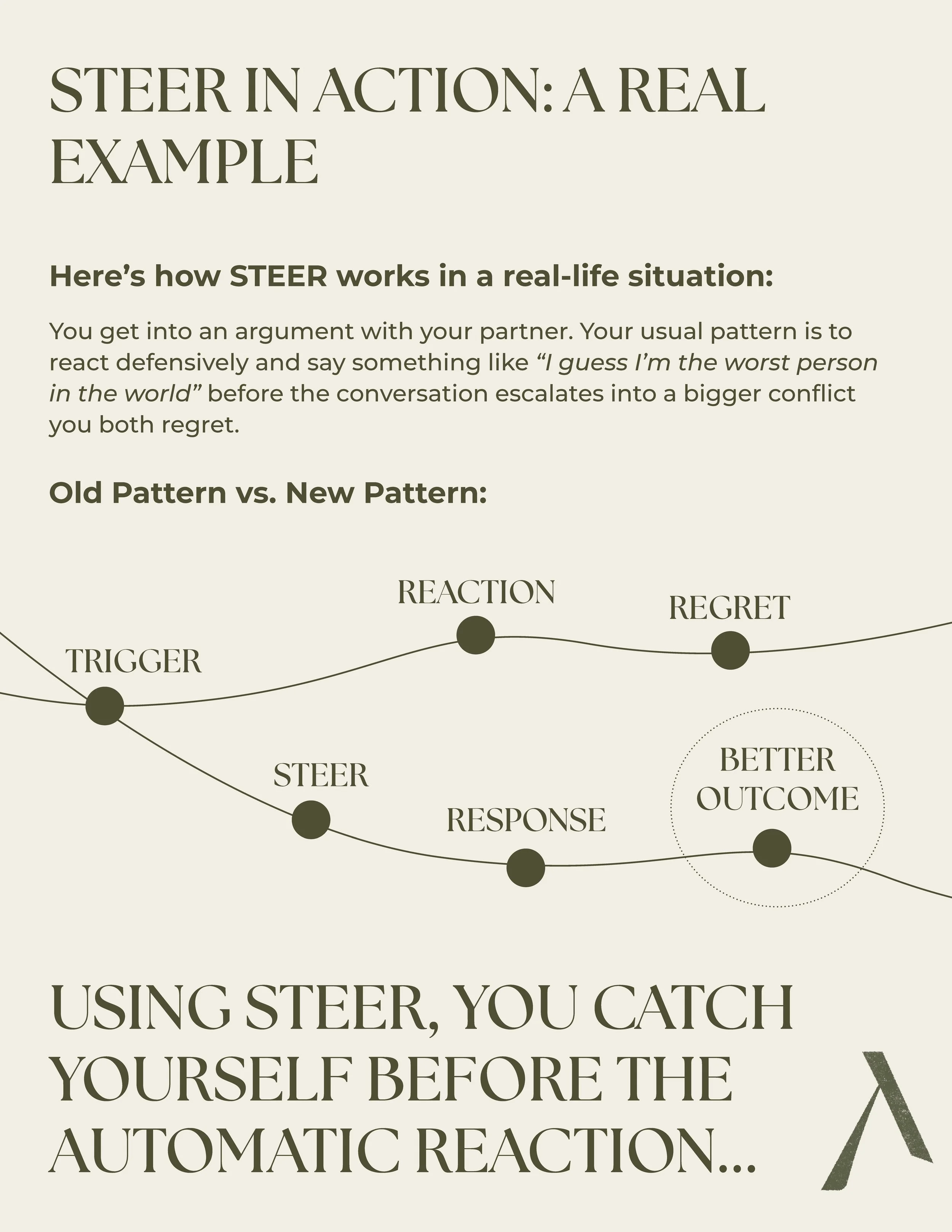
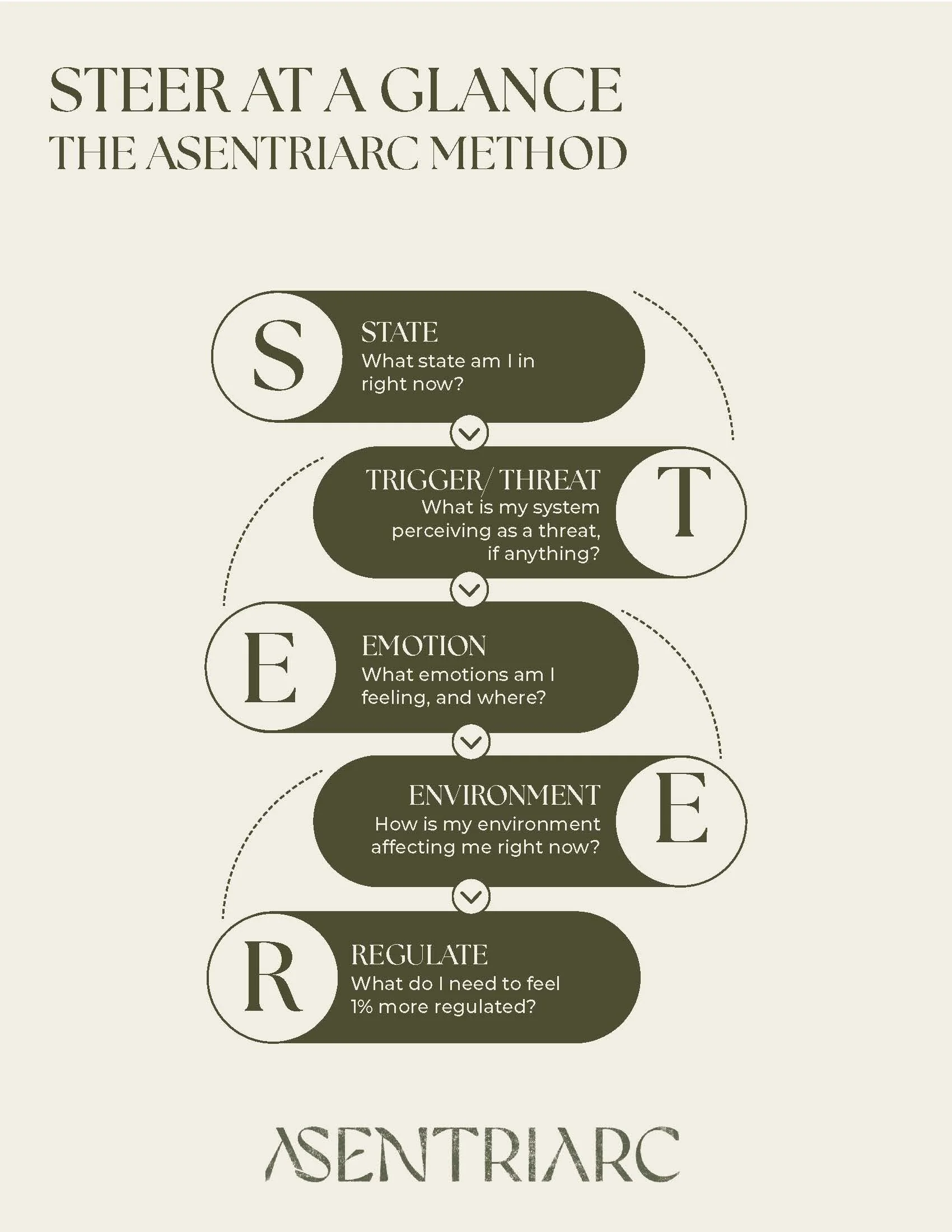
It's a way of orienting — a five-step practice that helps you slow down, get curious about your internal experience, and respond from a place of awareness rather than automatic survival patterns.
You can move through every step, or focus on just one or two. Some days, simply naming your State is enough. Other times, adjusting your Environment is where everything shifts. There's no right way to use it — only the way that meets your nervous system where it actually is.
STEER can take two minutes for a quick check-in, or fifteen when you want to go deeper. You decide, based on your capacity in the moment.
Awareness creates choice. Choice creates space. And space is where you take back control of your steering wheel.
S · State What state am I in right now?
Before you try to change anything, pause and notice.
Not "how are you?" in the social sense — but what is your body actually doing? Are you activated — heart racing, jaw tight, thoughts spinning? Are you shut down — foggy, flat, going through the motions? Or are you somewhere in the middle: present, grounded, able to respond rather than just react?
You might notice yourself feeling anxious or overwhelmed. Reactive or protective. Angry. Numb. Lonely. Disconnected.
All of these are valid. None of them are permanent. States are temporary nervous system responses — not personality traits, and not the truth about who you are.
Naming your state is the first act of steering. Because you can't navigate from a place you haven't acknowledged you're in.
The Five Steps
Each letter in STEER is a question — an invitation to get curious about what's happening in your nervous system before your mind decides what it all means.
T · Trigger / Threat What is my system perceiving as a threat, if anything?
Your nervous system doesn't respond to what's actually happening. It responds to what it perceives is happening — based on everything it has ever learned about safety and danger.
A trigger doesn't have to be dramatic. It can be a tone of voice. A look across a room. An email that lands wrong. A moment of silence that should feel peaceful but instead feels ominous. Your system might be responding to something happening right now — or something familiar from a long time ago.
This step isn't about cataloguing everything that sets you off. It's about getting curious — gently, without judgment — about what your nervous system has learned to treat as a threat.
Simply noticing what your system is responding to helps reduce confusion. And it creates space — between stimulus and response — where choice becomes possible.
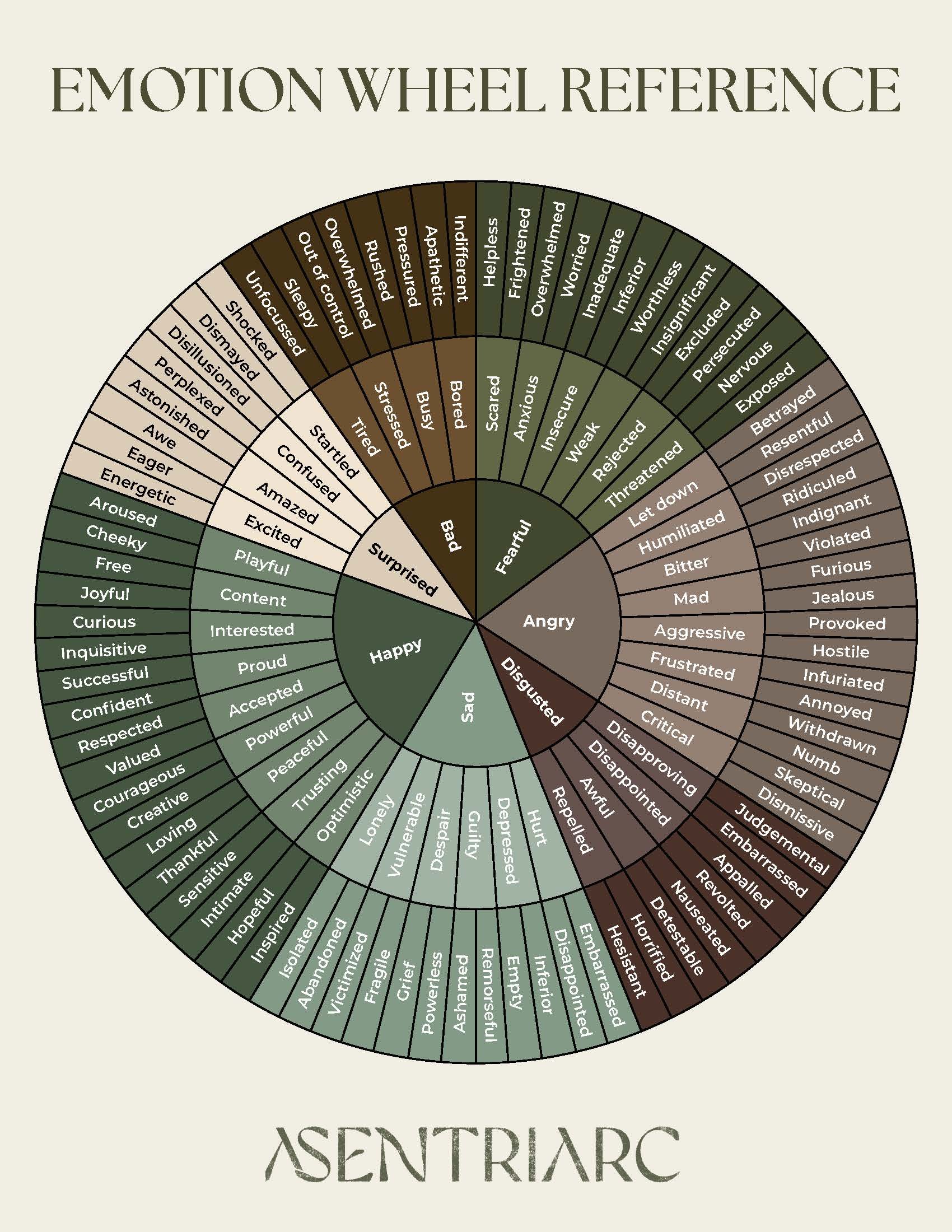
E · Emotion What emotions am I feeling, and where?
When the nervous system is triggered, emotions can feel intense, layered, or impossible to name. This step invites you to slow down and listen more closely — not to figure out what you should be feeling, but to notice what's actually present.
You might start simple: I feel bad. I feel activated. Something is tight in my chest. That's enough. There's no pressure to identify the "correct" emotion or to process anything in the moment.
Over time, you may begin to notice more nuance — fear beneath the anger, grief beneath the numbness, longing beneath the shutdown. But simple awareness is always valid, and always the right place to start.
You don't need to analyze or resolve what you find. Simply noticing and naming what's there, at a pace you can tolerate, helps your nervous system feel understood — and that understanding itself is regulating.
E · Environment How is my environment affecting me right now?
Safety isn't only something that happens inside you. It lives in rooms. In relationships. In the quality of light, sound, and the presence — or absence — of people who feel safe to be near.
Your nervous system is constantly scanning your surroundings, asking: Is it safe here? Am I alone? Can I be seen?
This step invites you to look outward. What is your environment doing to your nervous system right now? Is the space you're in helping you regulate — or keeping you stuck? Is there something small you can adjust — stepping outside, lowering noise, moving to a different room?
Sometimes regulation looks like an internal practice. And sometimes it looks like changing the room.
R · Regulate What do I need to feel 1% more regulated?
Not 100% better. Not calm. Not fixed.
Just 1% more regulated than you are right now.
This is where the steering actually happens. Once you know your State, understand your Trigger, have named something of the Emotion beneath it, and taken stock of your Environment — you're finally in a position to ask the most useful question of all: what does my nervous system actually need right now?
Not what should I do. Not what would look like coping. What does my body need?
Sometimes it's movement. Sometimes it's stillness. Sometimes it's cold water on your face, a hand on your heart, or shaking out the activation energy that's been building all day. Sometimes it's simply saying out loud: I need a minute — and meaning it.
The STEER Method doesn't give you one answer. It gives you the ability to find your own. And it builds — over time, through repetition — the trust that your nervous system, when met with enough curiosity and enough safety, already knows the way back.
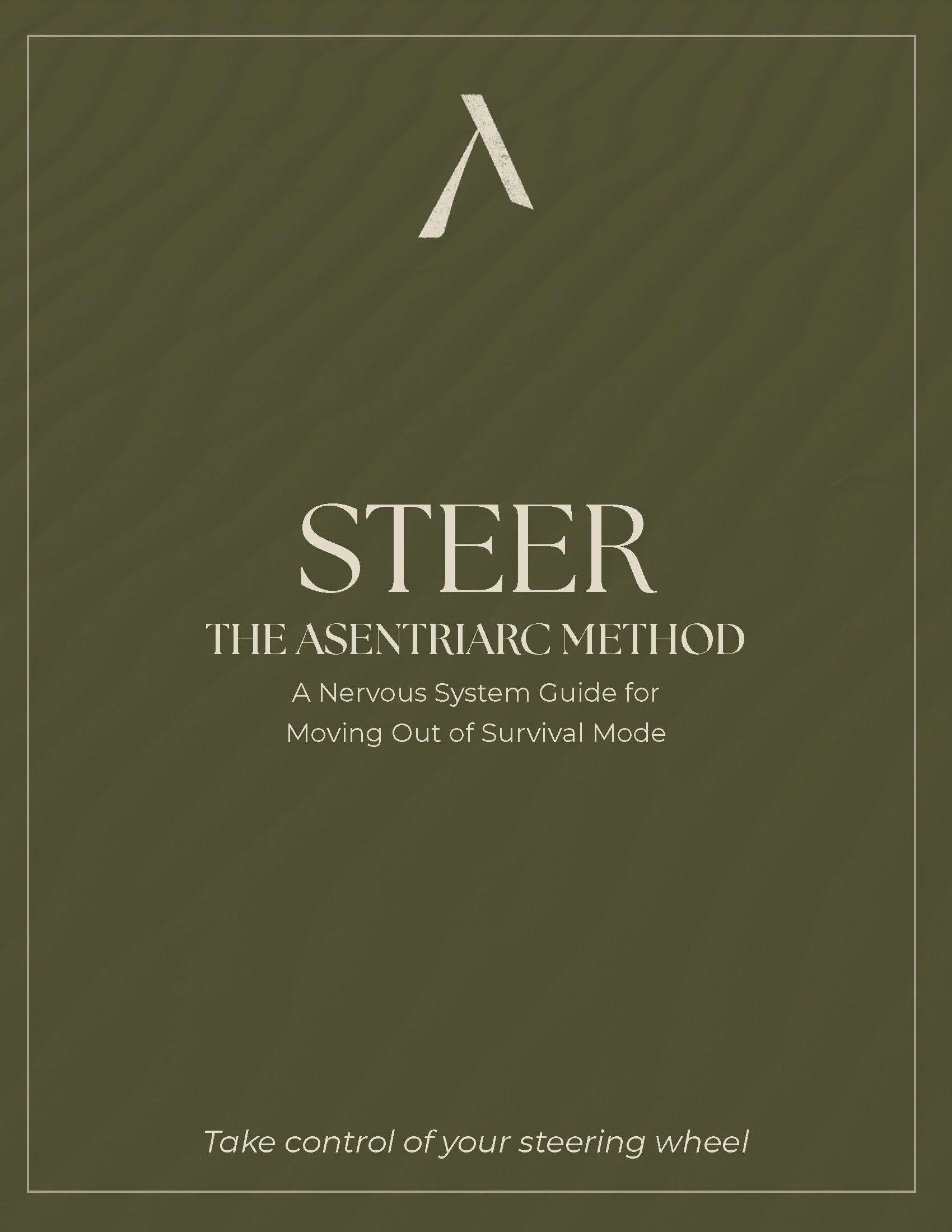
STEER helps you pause between trigger and response. In that pause, you find your power to choose.
What This Actually Looks Like
Theory is one thing. Here's STEER in two ordinary, recognizable moments.
You get into an argument with your partner.
Your usual pattern: react defensively, say something you regret, spiral into conflict you both wish hadn't happened.
With STEER:
S — State: My chest is tight. I'm holding my breath. I'm in defense mode.
T — Trigger/Threat: My partner's tone reminded me of feeling criticized. My system thinks I'm being attacked.
E — Emotion: I'm feeling hurt underneath the anger — and scared of being "too much" or getting it wrong.
E — Environment: We're in the kitchen, both tired after work. The space feels chaotic. I'm already overstimulated.
R — Regulate: I need to pause before I say something I'll regret. I can take a breath and say: "I need a minute."
The result: Instead of an automatic reaction that escalates the conflict, you take control of your steering wheel. You respond from a regulated place, preserve the relationship, and model exactly the kind of communication you actually want to have.

Your boss criticizes your work in front of the team.
Your usual pattern: smile, say "got it," then spiral into shame and self-doubt for days.
With STEER:
S — State: My throat is tight. My mind went blank. I'm in shutdown.
T — Trigger/Threat: Public criticism reminds me of being singled out before. My system thinks I'm being humiliated.
E — Emotion: I'm feeling ashamed, embarrassed — and underneath that, angry it happened publicly.
E — Environment: Bright conference room, everyone watching. I feel exposed.
R — Regulate: I need to orient myself. Look out the window. Take a sip of water. I can say: "I'll think about that feedback and follow up with you" — instead of agreeing to everything while I'm still shutdown.
The result: You give yourself space to process instead of collapsing into shame. You respond professionally without abandoning yourself. Later, regulated, you can assess the feedback clearly — and decide what's actually useful.


A Note From Sarah
Why I built this
I built the STEER Method because I kept watching something happen in the therapy room that didn't sit right with me.
People would arrive, brilliant, self-aware, sometimes with years of therapy behind them, and they could tell me exactly what their patterns were. They understood, intellectually, why they reacted the way they did. But they couldn't stop it. In the hard moments, they would fall right back into old patterns.
Understanding your nervous system isn't the same as being able to navigate it. Insight is the map. STEER is learning how to drive.
I wanted something I could put into people's hands that would truly help build space before the old habits took over. Not just in sessions, but in the ordinary moments when things get hard and the tools they've been given aren't quite working. Something that leads them to be the expert of their own experience. Something gentle enough to use in the middle of a hard day, and deep enough to build real capacity over time.
Your patterns aren't failures. They're protective responses that once kept you safe. What STEER offers is not judgment of those patterns, but a navigation tool to help you make a different choice when you're ready for one.
— Sarah Ferland Doherty, MSW, RSW, Founder of Asentriarc Wellness